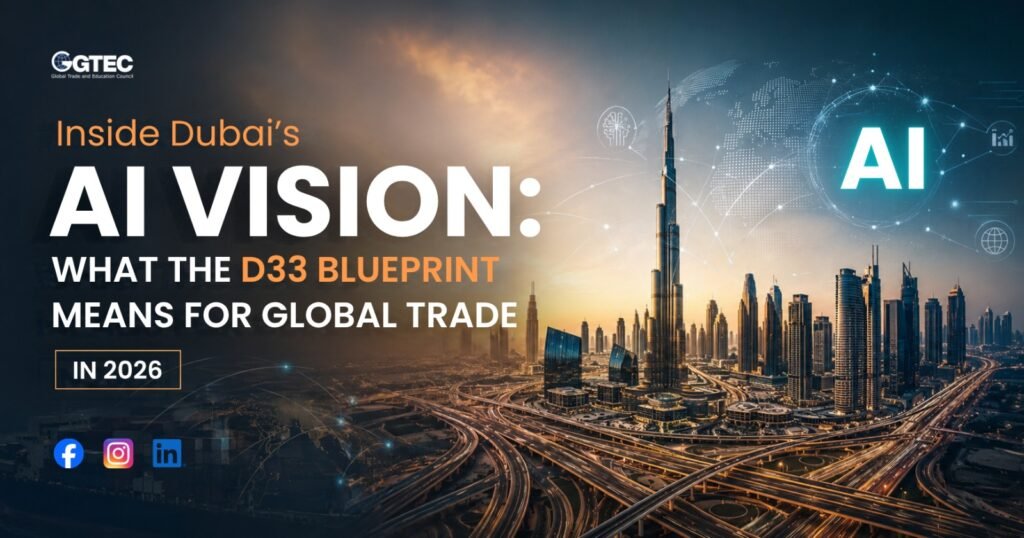
There’s a version of “AI strategy” that most governments talk about, and there’s the version Dubai is actually building. The difference matters especially if your business is trying to figure out where to place its next international bet.
Most national AI conversations are still framed around pilots, task forces, and five-year roadmaps. Dubai’s is framed around transformation targets with dates attached: a digital economy contributing AED 100 billion annually to the emirate’s GDP, a financial centre going fully AI-native, and a plan to bring artificial intelligence into nearly 300,000 companies not eventually, but now.
For any business watching the UAE as a market, a partner, or a launchpad into the region, this shift changes the calculus. Here’s what’s actually happening, backed by verifiable 2026 data and where GTEC fits into it.
Dubai’s AI Ambition, By the Numbers
Dubai’s AI push sits inside a larger economic framework called the D33 Agenda the emirate’s plan to double its economy by 2033. Within that agenda, digital transformation and AI aren’t a side initiative; they’re a primary growth engine. The D33 agenda explicitly targets the creation of a digital economy that contributes AED 100 billion annually to Dubai’s GDP, with AI serving as the enabling technology for virtually every component of that target from smart city operations to autonomous systems.
That ambition scales up at the national level too, The UAE has a vision to become one of the leading nations in AI by 2031, in alignment with the UAE Centennial 2071, aiming to create new economic, educational and social opportunities while generating up to AED 335 billion in extra growth. The UAE Strategy for Artificial Intelligence was launched in October 2017 as part of the broader Centennial 2071 vision, and it aims to integrate AI across key sectors including healthcare, education, transportation, energy and government services.
And this isn’t a strategy sitting in a policy document. In June 2026, Dubai’s government approved one of the most extensive AI adoption frameworks in the world.
Officials reviewed a comprehensive transformation programme aimed at empowering 295,000 companies across Dubai, with agentic artificial intelligence AI systems capable of executing tasks, making decisions and managing workflows with minimal human intervention positioned as a core driver of productivity and competitiveness.
From Government Policy to Grassroots Adoption
What makes Dubai’s approach distinct is how deliberately it’s building adoption at every level government, enterprise, and startup at the same time.
On the SME side, a digital trade support initiative delivered in partnership with Amazon has expanded to more than 105,000 companies by May 2026, surpassing its original target of 100,000 firms, while the “Ignyte” platform has recorded more than 36,000 users and delivered over 3,000 specialised mentoring sessions for entrepreneurs seeking funding access and operational support. Meanwhile, the Dubai AI Campus now hosts over 400 specialised companies and has trained more than 1,500 participants through its AI Academy.
The startup and investment ecosystem is scaling in parallel. Step Dubai 2026, now in its 14th edition, is expected to welcome more than 8,000 attendees and 400+ startups, with founders gaining access to investors representing over USD 12.6 billion in deployable capital. This year’s theme “Intelligence Everywhere: The AI Economy” reflects a deliberate shift toward treating AI as part of the wider business infrastructure founders already rely on, rather than as a separate technology vertical.
And at the flagship level, Dubai AI Week 2026 is bringing together more than 5,000 business leaders, 500 investors, and 100 exhibitors from 100 countries, organized under the Dubai Universal Blueprint for Artificial Intelligence and the patronage of Sheikh Hamdan bin Mohammed bin Rashid Al Maktoum, Crown Prince of Dubai.
The strategy is overseen by HE Omar Sultan Al Olama, the UAE’s Minister of State for Artificial Intelligence, Digital Economy, and Remote Work Applications the world’s first minister-level government position dedicated to AI under whose leadership the UAE has deployed AI across 100+ government services and established the world’s first AI university, MBZUAI.
The Financial Sector Goes AI-Native
Perhaps the clearest signal of how seriously Dubai is executing this vision came in April 2026, when the Dubai International Financial Centre made an unprecedented commitment. DIFC announced it will become the world’s first AI-native financial centre, embedding artificial intelligence at the foundational level of its legal frameworks, business environment, talent development, ecosystem infrastructure and physical urban fabric.
This isn’t a symbolic gesture. By aligning with Dubai’s AI strategy and the UAE’s national ambitions in advanced technology, DIFC intends to translate research into regulation, innovation into deployment, and policy into practical infrastructure at speed and scale a commitment it is reinforcing through the Dubai AI Festival, which will convene more than 20,000 participants from over 100 countries in October 2026.
For a financial centre that serves as a gateway for international businesses across the Middle East, Africa and South Asia, this shift matters well beyond Dubai’s borders. It signals that regulatory frameworks, compliance processes, and business infrastructure across the region are being rebuilt around AI as a default not an add-on.
Why This Matters for Global Trade Right Now
Here’s the part that often gets lost in AI headlines: this transformation is already reshaping business expectations across the region.
In 2026, the UAE Cabinet approved a framework to deploy agentic AI across government operations, with phased adoption across ministries and federal entities building on years of digital transformation from eGovernment to UAE Pass and proactive digital services. When government services become AI-driven, customer expectations shift with them people begin to expect faster approvals, better personalization, fewer repeated forms, and 24/7 digital response, and private companies feel the same pressure.
The regional economic case is significant too. PwC estimates that AI could contribute US$320 billion to the Middle East economy by 2030, with the UAE expected to see the largest relative impact in the region at close to 14% of 2030 GDP. Yet adoption still has room to mature Deloitte and MBZUAI’s 2025 research found that 69% of Middle East organizations plan to increase AI investment, while many still face gaps in talent, technology and risk governance.
That gap is exactly where opportunity lives for businesses entering the market today. A government and financial system rebuilding itself around AI-first infrastructure means faster processes for the businesses that understand how to operate within it and friction for those that don’t.
Where GTEC Fits Into Dubai’s AI Story
GTEC isn’t an AI company, and we don’t need to be one to matter here. Our role is more fundamental: we help businesses actually operate inside markets like the UAE and right now, operating inside the UAE increasingly means operating inside an AI-accelerated business environment.
That shows up in a few concrete ways:
- Faster-moving regulatory and compliance environments. As government services and financial infrastructure modernize around AI, the businesses we facilitate need partners who understand what’s changing and when not just what the rules were last year.
- New sector openings created by the AI push itself. Dubai’s AI transformation isn’t confined to tech it’s touching finance, logistics, government services, education and manufacturing simultaneously, which means new categories of partnership opportunity for businesses across GTEC’s 12+ industry sectors.
- Verified connections in a fast-moving ecosystem. With hundreds of thousands of companies, thousands of startups, and billions in deployable capital moving through this transformation, visibility and trust matter more than ever. GTEC’s role verified buyer-seller matchmaking, sector-specific facilitation, and on-the-ground presence in the UAE is designed for exactly this kind of environment.
The Takeaway
Dubai isn’t experimenting with AI. It’s rebuilding its economy around it with dated targets, government-level ownership, and measurable adoption across companies, startups and financial infrastructure. For international businesses, that means the UAE market of 2026 already operates differently than it did even two or three years ago.
The businesses that understand this shift early and build the right partnerships inside it will be the ones positioned to benefit as Dubai’s AED 100 billion digital economy target, and the UAE’s AED 335 billion AI growth ambition, move from strategy to reality.
If your business is looking at the UAE as part of its global trade strategy, that’s a conversation worth having with people already operating inside this shift.